Tuesday, November 17, 2020

Another one done

Though it's been done for months, I never got around to posting pictured of my M16A1 build.  To recap, the lower is a standard 80%, the barrel is a JSE 20" Lightweight profile, the sling is GI surplus, and every single other part is original Colt M16A1(with FCG parts modified for semi-auto only).  The new lower was painted with fake worn pain, everything else has it's original worn Colt finish.  I'm still want to find a "correct" 20rd Colt magazine, but this original 30 rounder will work for now.


Thursday, November 5, 2020

Are you mocking me?

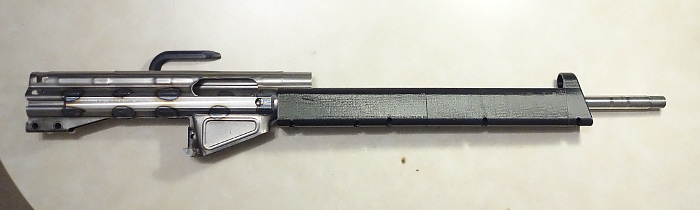
I finally have enough pieces that I can mock up my PSG-None.  None of the 3D prints are glued together yet. Even though I'm likely going to paint all the 3D printed parts, I printed them in black so that if/when they get scratched, the scratch won't show as much(except for the buttpad which is red because that's the only color of Ninjaflex TPU I have).


Sunday, November 1, 2020

More faking it while making it

Because this is a low dollar range toy, I didn't want to buy a high end match barrel that cost more than all the other parts of this project combined(and I'm not a good enough shot for a barrel like that anyway).  The barrel I'm using is an 18" CETME barrel from Apex.  It is a very nice barrel, well machined and reasonably priced.  There is one problem with it though, it's 18" and not the 25.6" of the PSG-1, and it's too thin compared to the heavy barrel contour of the PSG-1.  Because of that, it looks obviously too short and too thin with my 3D printed PSG-1 style handguard.


Don't worry though, I have a plan for that.  The muzzle on the Apex barrel is threaded 5/8-24, a standard size for 30 caliber muzzle brakes and flash hiders.  So I decided that I would just make a barrel extension that threaded on.  In addition to being an extension, it's also a sleeve that slips over the barrel until it's under the handguard to make it appear that the whole barrel is heavier.  I used some 3/4" 1144 stressproof steel bar(because that's what I had handy), drilled all the way through it with a really long 11/32" drill bit(three actually, short, medium, and long, and it took me all afternoon to drill on the lathe), then counterbored it to fit over the barrel, with a smaller step 5" down for the threads, and tapped it with an $11 e-bay 5/8-24 tap.  I had my doubts about the e-bay tap because it was so cheap, but it cut great and still looks like new.  I had to get creative with the tap holder because the tap is 4" long and the threads are 5" down in the hole, and I ended up sacrificing a thin wall 12 point socket for it.  Here's where the extension sits on the barrel, if you could see a cutaway of the extension, you'd see about an inch of threads in line the barrel's muzzle.

With the extension in place, the overall barrel is the same length as the PSG-1, and looks much better with the handguard.


I also put a recessed crown on the barrel extension instead of the flat crown on the PSG-1, mostly because I don't trust myself not to ding it up.  11/32 is only .035" bigger than .308, so it's not too noticeably bigger at a casual glance, and hopefully it won't affect accuracy.  I also don't know for certain that the drill didn't wander, but being cut on the lathe all from one direction hopefully it will be close enough.


A barrel of fun

One of the things I've been avoiding the most on my CETME build is pressing the barrel into the trunion.  I actually bought my press specifically for this one thing, and I still put off it as long as I could.  The reason I wasn't looking forward to it is because it has to be very precisely located, and hydraulic presses aren't really known as precision equipment.  Unlike a normal gun where we'd need headspace gauges to check our clearance, HK and CETME roller delayed guns are measured by checking the bolt gap.  If the barrel is pressed in too far or not far enough the gun won't be safe to shoot, and the go-no go range is about .015"(about the thickness of 5 sheets of notebook paper). 

Since my lathe is up and running, I turned a brass piece to use for pressing the barrel.  Here it is ready to press the barrel.  There is a nub on the end that fits into the chamber to keep it centered.


I covered the barrel in anti-sieze and pressed the barrel most of the way using the brass piece, stopping and checking often.


Once it was most of the way there, I switched to using the bolt assembly it's self to press it the rest of the way.  My press plate has a hole close to the edge to give the bolt carrier some room.  I also put .020" shims between the bolt head and the bolt carrier to make sure I maintain my bolt gap.  My brass pusher piece has a hole in the center to clear the firing pin while pressing on the bolt carrier.

There was still a lot of pressing-checking-pressing-checking, etc.  Once I got close I put the trunion in the receiver and checked the gap.  Outside of the receiver the bolt head can wiggle a bit and throw off the reading, so it should always be checked with everything assembled.  The bolt gap spec for CETME and G3 based rifles is .004"-.020".  New builds tend to "settle" a little bit after firing and the bolt gap will close up some, so you want to shoot for the high end of the spec.  If you miss the spec or you shoot enough that you actually wear it out, over and undersize rollers are available, but it's best to try to get it in spec.  I ended up right at .019".

You can see all my welds here in their disappointingly sloppy Mig welded glory.  The trunion, receiver, and reinforcement rail are also all welded together at once through the hole that was drilled in the reinforcement rail.  While I was at it, I also drilled the holes for plug welding the cocking tube.

 
I left the barrel pin hole undrilled until the the trunion was welded into the receiver in case things moved a little while welding(and nothing did).  Normally, machining something like this is a pain because the existing hole in the trunion will want to make the drill bit wander as it's trying to drill through the barrel.  CETMEs and HKs are a bit different though.  The trunions on these things are HARD.  They will just laugh at a standard drill bit.  Because of this, you can use the trunion as a drill guide to drill the softer barrel.  The barrel pin is 5mm exactly.  Instead of drilling and reaming the barrel for the pin, the easy thing to do is to drill it with a #9 drill bit.  A #9 drill is just .0008" under 5mm, and makes for a good press fit without reaming. 


I'll just shelf this one for later.

Since using the stock front grip pin on my CETME makes it a machine gun by default, I am going the standard route for semi-auto HKs and replacing the front grip pin with a shelf welded on the receiver so that an unmodified full auto grip cannot be installed, with a matching shelf welded into the grip assembly.  Conveniently, this is the same method HK used on the real PSG-1 so I won't have to put a fake pin in like a lot of people do.  Since it was always intended to be a semi-auto marksman's rifle, the PSG-1 was set up from the get go with a semi shelf already installed.  Since I'm cheap, I decided to make my own shelf on the mill even though they are commercially available.  To locate the shelf on the receiver, I printed up a locating jig that is available on Thingiverse.  

The grip assembly needs to have a matching shelf welded into it.  I made one out of a piece of angle iron I had laying around.  I also made sure that the modified trigger box fit with the shelf in place before I welded everything.  In hindsight, I should probably have milled one that looks nicer, but it works fine and didn't take long to make.


With those pieces welded in, I could start fitting things together, and it's finally starting to look like something.


Tuesday, October 13, 2020

Ridin' the rails

Another one of the things that sets the PSG-1 apart from a standard HK G3 is it's reinforced receiver.  The sheetmetal stampings are basically the same except that the PSG-1 is missing the G3's scope mount lugs.  The PSG-1 receiver gets it's extra strength from some reinforcement rails that get welded to the side of the receiver.  As with most things, reproductions are available, but they are expensive and I am cheap, so I made my own.

This whole CETME projects is an exercise in fake it 'till you make it, and still there are times when I annoy myself because even when I'm half-assing things I often have to take the steps to do it "right."  I drew up some reinforcement rails based on pictures and the few measurements I could find online.  If you've been following my posts long enough, you know that I hate everything about machining steel and avoid it as much as I can.  I thought about 3D printing the rails and gluing them on, but decided that was too fake even for me.  Then I thought about making them from aluminum and bonding them on with JB Weld(which I'm fairly certain would actually work pretty good), but it still wouldn't be right with no visible welds.  So I finally settled on making them from steel...sigh...

I used plain mild steel and here's how the rails look after machining:


They look fairly straight forward, and they are, but the back side isn't really something that could be easily done without a CNC. The contour on the back side has to match the shape of the receiver.  Here's how they sit on the receiver:

 I was able to talk myself into some Tig time to weld them on. The actual PSG-1 has a single plug weld towards the front of the rails, and it wasn't until I stared fitting mine that I figured out why.  With a plug weld in that location, the rails, receiver, and trunion can all be welded together as a unit.  Fortunately I realized it before welding, so I pre-drilled the hole for a plug weld for when I weld the trunion in.  I also had to notch the right rail around the ejection port, which seemed wrong to me, but that's how HK does it too.  It's just five short welds across the top and bottom but I am very out of practice making small welds on steel, so they aren't the prettiest.  Low amps, no backer, no burn through, and I still have perfect bolt drop so I know I didn't warp anything. 


Saturday, October 3, 2020

My 3D printed CETME and HK G3 bending jig

Update: If you're here because you bought a 3D printed jig on Gunbroker, that jig was printed and sold without the seller asking permission to use my design.

So that...actually..worked?  I'm always a little surprised when my harebrained schemes actually work the way they're supposed to, and my 3D printed CETME folding jig worked nearly perfectly.  There are going to be a lot of pictures in this post...

Here are the main pieces of the jig.   As I said in my last post, the mandrel portion is made from more pieces than it needs to be because I changed my mind halfway through printing and didn't want to reprint everything, so I just printed the extra bits and glued them on.  The lower jig has clearance cutouts that should work for CETME and G3 flats, although I goofed on the ejection port location and had to do some grinding on the jig.  I'll update the files for that before I post them.  Each part has two 1/2" hardwood dowels connecting and aligning the pieces, and depending on your printer's tolerances after printing you will probably have to chase the holes with a 1/2" drill bit.  Based on a user review, I recommend not gluing things together so that you can adjust the length of the jig in case the alignment holes in your flat are off.  The holes on the ends of the jig are sized for 1/4" bolts, through the mandrel and threaded into the lower jig.

It's printed in eSun PLA+, standing on end, .16 layer height, 8 walls, 15% Gyroid infill, .45mm line width(with .4 nozzle), 107% wall flow and 120% infill flow to "overstuff" the layers for better layer adhesion, a higher than normal 220°C and only 70% cooling fan, again for better layer adhesion.  These are the basic setting for all my "strong" parts(the only difference with my printed receivers is that I use 99% infill there).  Using these setting I get significantly stronger prints than the "standard" print settings, at the cost of a not quite as smooth surface finish.  With these settings, if my prints fail, they crack through the part, or just kind of mush over, I do NOT get any layer separation.  People tend to think of PLA as a weak and brittle filament, but the reality is that it has nearly twice the tensile strength of ABS and PETG, and more compression strength than either of the others.  It's biggest drawback is that because it is so rigid, it tends to crack in situations where ABS or PETG would just flex.

There are four more pieces to the jig not pictured above.  The top half of the mandrel portion of the jig is undersized so that the sheetmetal has room to bend.  But, the whole point of this jig is to keep the flat straight as it bends, so there are some thin filler pieces to fill the gap between the mandrel and the sheetmetal in the later stages of the bending process.  Here's where they fit on the mandrel:

Here's how the mandrel fits the sheetmetal without and with the fillers:

Ok, now the real fun starts.  I used a short bar of aluminum to help spread the load across the top mandrel.  A longer bar would have worked better, but this is what I had.

I pressed a little, then moved the bar and pressed some more.  A little bit on this side...

A little bit on that side...


I went back and forth about 10 times, trying to keep things even.  I actually did very little pressing right in the middle, most of it was at the ends.  Once I got most of the way there, about what you see in the pic above, I put the filler pieces into the jig.  It was a tight fit and I had to (very)carefully tap them in with a hammer. 

With the spacers in, it was back to the press for more back and forth.  Once the magwell starts to close up, you've got to start getting creative with your press tools.  "Whatever is closest and will fit" is the method of tool selection that generally I use.  You want to try to keep as much surface area as you can, the more the load is spread out, the better.

With pressure on the jig, I gently tapped around the whole thing with a rubber mallet, just helping the sheetmetal form around the mandrel a little more.  At this point, I decided that it was as pressed as it was going to be.  The flat and mandrel were pressed tight against the bottom jig and there was no where left to go. 


Since the whole point of all of this was to try to keep the bend straight and even, and keep the receiver shaped properly, how'd we do?  I'd say pretty good...

After taking the bolts out, I had to use a rubber mallet to get everything apart, and I had to hammer the mandrel out of the receiver.  I got a slight wave in the sheetmetal above the ejection port, but that's mostly due to my putting the cutout in the wrong place on the jig.  It's also much more noticeable here than it is in real life.  Look Ma, I made a gun! (from a legal standpoint anyway)


It turns out that the lower jig is also great for holding things while you're welding too.  I put my recovered G3 stock attachment weldment in the back of the receiver, used a piece of copper tubing as a backer for the front portion, clamped on a whole lot of Vice Grips, and welded it all up.  


Even though it should be Tigged to be correct, I Mig welded everything because that's what I have at the moment.  I've spent a whole lot of time doing sheetmetal work on cars, so welding up a receiver this thick was no problem.  The welds weren't factory Tig pretty, so I ground them all down and this is what I ended up with:

The true test of a CETME/HK folded flat is the bolt drop test.  Basically, you drop the bolt carrier through the receiver and it should freely drop through with no interference or drag.  I checked it after every step along the way.  So how'd I do?   Fresh off the jig: Perfect.  Tack welded: Perfect.  Fully welded: Perfect.  As best as I can tell, this receiver is as close to perfectly shaped as a home build can get.

And what of our jig, how did it hold up?  Pretty good. One of the add on end pieces I superglued on the mandrel came off, but it was a glue failure, not a print failure(the files I'll post will have that as one piece).  The lower just has a few scrapes in it, and a mushed spot where the ejection port flares out and that's about it, no other damage(and I'll fix the ejection port cutout in the file before I post it).  This thing worked so well that it could probably be done in a bench vice or with C-clamps, if you have some big enough, or possibly even by using 1/4" All Thread and some nuts to pull the two parts together with C-clamps for the middle.  Total cost for this jig was around $20 in filament, and about 3 days of print time.


If you want to make one for yourself, you can find my STLs here:

 https://www.thingiverse.com/thing:4614385