Sunday, August 11, 2013

The Fast and Cheap

One of my myriad of projects is the Fast and Cheap.  It's my attempt to get an RC car up to 100 MPH, and do it on a budget.  Anyone can build a fast car, anyone can build a cheap car, doing both is the challenge for me.  If you want to read the entire F&C Saga, here's a very big thread about it on the Ultimate RC forum:
http://www.ultimaterc.com/forums/showthread.php?t=171392

Well, I finally had time for some test runs.  Needless to say, it didn't end well.  At around 40-45 MPH, the car spun out then went airborne.  On the plus side, I got to 40 MPH and hadn't even gotten to half throttle yet :)


Friday, August 9, 2013

The little things

When I got the Viper, it had smooth silicone tube installed in place of the stock accordion looking intake tubes.  Who ever put them on must have bought the longest hose clamps they could find.  They were about 4" too long, and just looked bad. I can't stand unsightly hose clamps, and it'd been bothering me since the day I got it.  IMO, sloppy hose clamps can ruin a whole engine compartment.
I stopped down to the local Farm and Fleet, and bought a set of stainless T-clamps.  They look 1000 times better.
While I was changing the clamps, I noticed a small but very important thing.  The top alternator bolt was missing.  Fortunately, the alternator could rest on the bracket, or this might have ended very badly.  Be sure to look things over very carefully when you buy a used car...


Sunday, August 4, 2013

Brakes

It said right in the e-bay listing that the Viper needed front brakes.  When I got it, they did sound a bit grindy, so brakes were at the top of the to do list.  I got some new pads and pulled the fronts brakes apart, this is what I found:
He wasn't kidding when he said it needed brakes!  This is what original brake pads look like after 44,000 miles.  Two of the pads were down to the metal backing.  Fortunately the rotors weren't too scored up and I was able to turn them clean.  Now where did all that pad material go?  Found it!
I don't think the back sides of the wheels on this car have ever been cleaned...


Dipped the Harley

The old Shovelhead was purple when I got it.  It was a nice color, just purple.  Then I bought some saddle bags for it.  Since I'd planned on painting the bike anyway, I just rattle canned them black temporarily.  That was 8 years ago.  I've hemmed and hawed over what color to paint is for a few years now, I just can't make up my mind.  Then just recently, Plasti-Dip introduced a line on metallics.  One of the colors consistently towards the top of my list is Anthracite, and conveniently, Plasti-Dip now makes one.  Three cans later, I've got a gray bike :)


Exhaust

The previous owner described the exhaust as "Nasty."  He was right.  It was terrible.  At anything above idle, it had the classic UPS truck sound.  After pulling the side sills, this is what I found.  The cats had been replaced with straight pipe, and that pipe wasn't connected to the head pipes.  Basically, it was running open exhaust dumped into the side sills.  Judging by the amount of carbon under the sills, he'd been running it for awhile. One of the very first things I did was reconnect those pipes.  The pipes were shoved into the resonators so far that even with my Dad's help, it was a fight to get them back in place.

Friday, August 2, 2013

Plasti-stripes

When I got my car, someone had already done some fixing on the hood(and not very well I might add).  There was a big primer spot on it covering the repair.  The repair area extended over the stripes, and stood out like a sore thumb.

I decided to do a quick fix until I get into major bodywork.  Since this is only a temporary job, I'm using Plasti-Dip.  If you're not familiar with Plasti-Dip, it's a spray on rubber coating available at hardware stores and online at places like www.dipyourcar.com.  It comes in a variety of colors and can be used for anything from cars to tools.  Plasti-dip's best feature is that while it sticks well, it's very to remove.  You just start pulling at an edge, and the Dip peels off in big sheets leaving the original finish untouched.   Since it's not a permanent coating, I wasn't too concerned about overspray so I didn't have to mask the whole car. 
Most colors of Plasti-Dip cover well, but the white is pretty thin.  It took a whole can to cover the blue primer spot. I also blended it back so I didn't end up with a hard tape line towards the top.
One of the tricks to Dip is that you need to remove the masking right away.  If you let the Dip dry, it will start peeling off as you remove the masking tape.  Once it's had a few days to throughly dry, using a product like Meguiar's Ultimate Quick Wax will greatly increase it's durability.  Here she is, stripes one again continuous.  Any overspray on the body simply wipes off.  The color is slightly off, and there's still obviously a primer spot, but the overall look of the car is much improved by this one little detail :)


Tuesday, July 30, 2013

Hood alignment

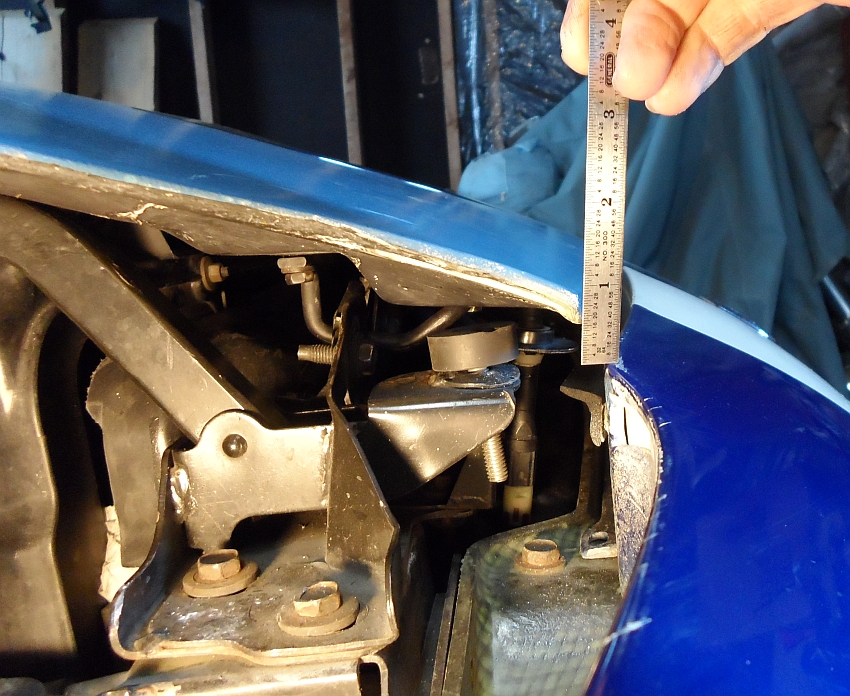
With the new door installed and adjusted, I could get the hood fitting better.  When I got the car, the passenger front corner of the hood wouldn't even latch.  I finally got it to latch, but the edge of the hood was a full 3/4" higher than the fascia.

I couldn't figure out how to lower the hood any further, and the hinges were definitely not bent.  After a few hours of head scratching, I realized that that the hood wasn't high, the bumper was low.  Turns out that when the nose slid under what ever it slid under, the whole bumper assembly was shoved all the way down in it's slots.  I also discovered that the headlight on that side had been replaced.  I'm guessing the original was shattered in the accident.  After nearly 12 hours of  screwing around, I finally got the doors adjusted to the body, hood set to the doors, bumper set to the hood, and headlights fit to the openings.  All the gaps are good, but not great.  Since I need to take it apart to do bodywork anyway, I decided they were good enough for now.